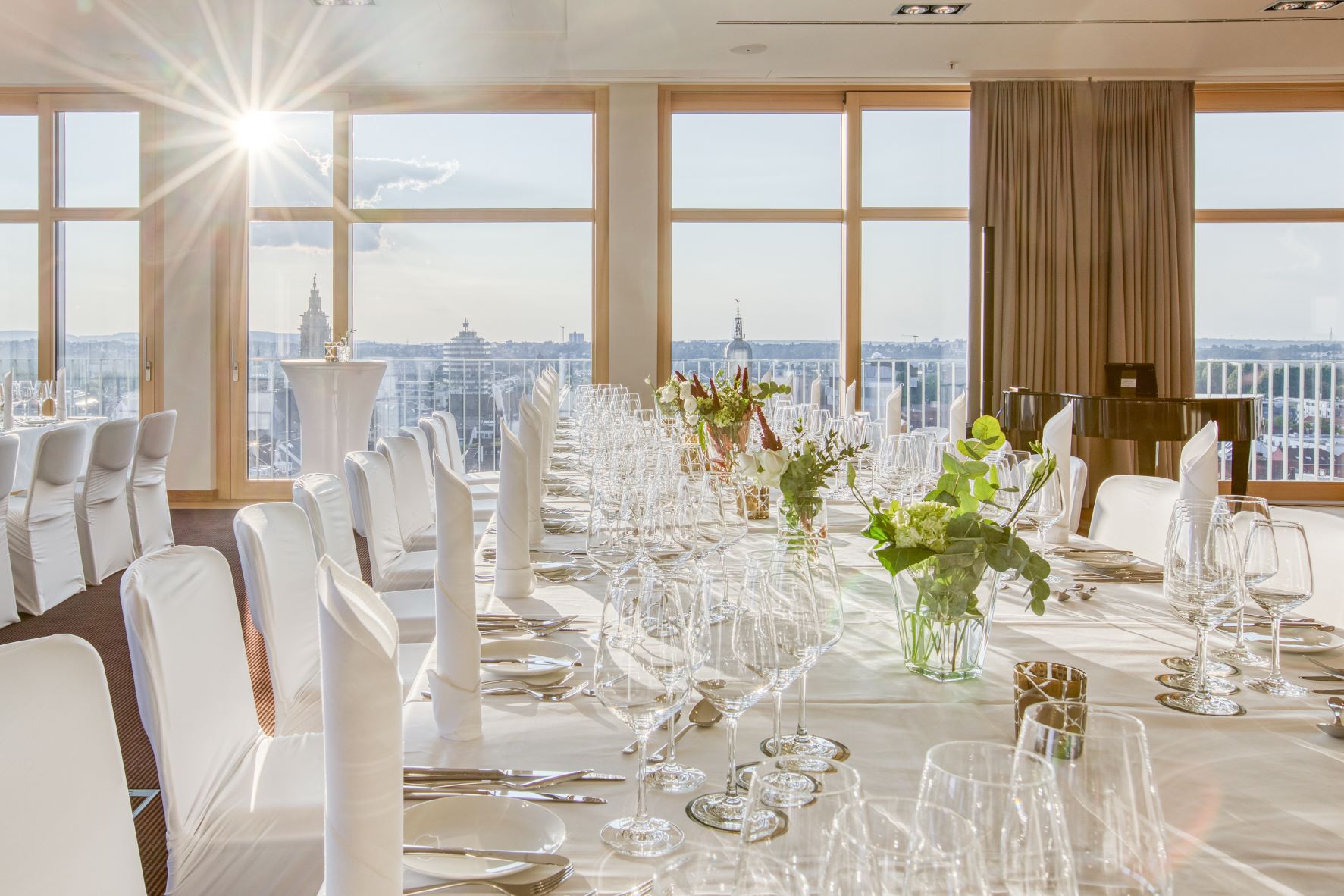
CASCADE 2027 will take place at the Bildungscampus Heilbronn, a new developed area which hosts several academic institutions, including branches of TU Munich and ETH Zurich, Max-Planck and Fraunhofer institutes, and is 1 kilometer away from the new branch of imec in Germany. The conference will take place in two buildings: Conferencing Area building on Monday and Tuesday, and in the Forum building on Wednesday. The welcome reception on Sunday will be in the Campus Garden restaurant in the Forum building. The social event on Monday will be in Parkhotel Heilbronn, in the Panoramasaal on its 10th floor. These locations, as well as the sights and hotels in Heilbronn listed below, are easily reachable by foot from Heilbronn railway station.
Google Maps railway station -> conference area -> Alte Reederei (see below) -> imec location: Maps
Heilbronn’s Gothic-Renessaince-style City Hall (Rathaus), originally built in 1417, hosts an astronomical clock from 1579 (Marktplatz 7). Nearby is the 14th-century Gothic Käthchenhaus (Rathausgasse 5). Two towers still remain of Heilbronn’s medieval fortifications: The Götzenturm (idol’s tower, Allerheiligenstraße 1) extended since 1985 with a silhouette of a balancing man, and the Bollwerkturm (bulwark tower, Platz am Bollwerksturm). The Deutschhof complex, established by the Teutonic Order, now hosts a museum for local history (Deutschhofstraße 6). The Fleischhaus, completed in 1600, had once served as a meeting location for the imperial court, and now is used commercially (Kramstraße 1). Heilbronn’s most remarkable church is the 13th-century Kilianskirche with a masterpiece gothic high altar by Hans Seyfer (Kaiserstraße 38). A further important church is the Nikolaikirche, close to the house of Robert Mayer, the inventor of the energy conservation law (Sülmerstraße 72).
Google Maps with Parkhotel (location of the social event on Monday) and the mentioned locations: maps.
A bit further away is the Trappensee lake with a Renaissance-Baroque castle that now hosts the Heilbronn House of Literature. For more pleasant water scenery, visit the Alte Reederei space (Am Neckaruferpark 20), close to the conference site.
An overview of these and further points of interests can be found on the city’s website points of interests (switchable to English on the bottom left).
Sightseeing in Heilbronn
Stuttgart, 40 minutes away, is home to Mercedes-Benz Museum and Porsche Museum. Both car makers also offer visits to their production sites, but these usually needs to be booked months in advance. Porsche’s factory tours are in Zuffenhausen while Mercedes lets you select between three different sites, of which Sindelfingen and Rastatt are nearby.
Stuttgart has some remarkable architecture, including the Weissenhof Estate designed for the 1927 exhibition “The Dwelling” under the artistic direction of Mies van der Rohe, with two of its houses (one by Le Corbusier) on the UNESCO World Heritage list (Rathenaustrasse 1). Other interesting buildings in Stuttgart are the world’s first Waldorf School in Uhlandshöhe (Haußmannstraße 44); the 217 meter high, first-of-its kind TV Tower (Jahnstraße 120); the Sepulchral Chapel Grabkapelle on the Württemberg Hill, called by some the “Swabian Taj Mahal” (Württembergstraße 340); and a wide range of Jugendstil (Art Nouveau) houses, two highlights being in Hasenbergstr. 86 and in Schickhardtstraße 45. Stuttgart’s oldest house, from mid-15th century, is an interesting Fachwerk building in Bad Cannstatt (Marktstr. 71, across the Neckar river).
Further points of interest in the region include the 452-room baroque Royal Residential Palace in Ludwigsburg (“Versaille of Swabia”); the Fachwerk city of Bietigheim-Bissingen – both are located between Heilbronn and Stuttgart; Leonberg with the historical bitter-orange garden, a range of Fachwerk houses including one where Johann Kepler lived, and a fountain dedicated to his mother who was defended by him in a witchery process. Beyond, interesting cities nearby are Strasbourg in France, Heidelberg and Freiburg in Germany, Basel in Switzerland, and the Black Forest region.